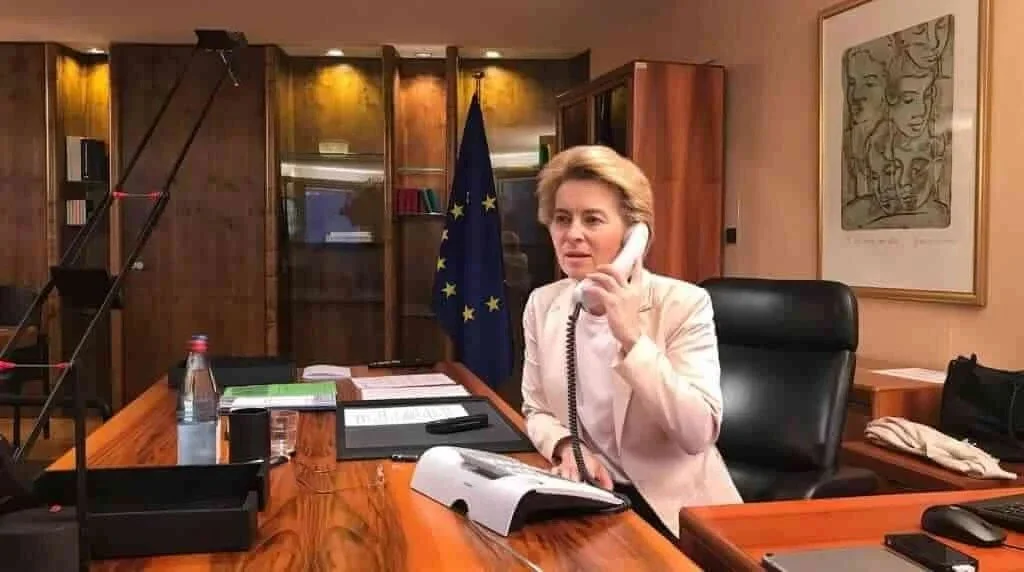
Guest At 2026 NATO Leaders’ Summit In Turkiye Does Not Have A Military, But Really Wants One. Awaiting EUAF. Problem Brewing On 13th Floor
One Guest At 2026 NATO Leaders’ Summit In Turkiye Does Not Have A Military, But Really Wants One
Awaiting EUAF
EU, G7, G20, NATO Problem Brewing On 13th Floor
Ursula Von Der Leyen Aspires To Lead An EU Army, EU Air Force, And EU Navy Under Her Control To Deploy As She Decides
Wants Twenty-Seven Divisions Controlled From 13th Floor Of Berlaymont Building At Rue De La Loi In Brussels
NATO Can’t Easily Corral Thirty-Two Members. Is Twenty-Seven The Magic Number?
Joining EU Article 42(7) TEU With To NATO Article Five?
Wants To Be An Admiral, Commander-In-Chief, Field Marshal, General, Generalfeldmarschall, Generalissimo, Grand Marshal, Marechal de France, Marshal of the Air Force, Supreme Commander of the Armed Forces
Perhaps, German DNA… Curbing Expansionist Desires
Do Not Be Surprised When EC Seeks A Permanent Seat At The United Nations Security Council
Taxpayers Throughout EU Increasingly Sour On Individual Member Electorate And Collective Increased Military Spending And Support For Ukraine
Dr. Ursula von der Leyen, President (2019-2029) of the twenty-seven-country member Brussels, Belgium-based European Commission (EC) wants an army, air force, and navy under her control to dispatch within the European Union (EU) and outside of the EU.
EU: Austria, Belgium, Bulgaria, Croatia, Cyprus, Czech Republic, Denmark, Estonia, Finland, France, Germany, Greece, Hungary, Ireland, Italy, Latvia, Lithuania, Luxembourg, Malta, Netherlands, Poland, Portugal, Romania, Slovakia, Slovenia, Spain, Sweden.
Mark Rutte, Secretary-General (2024-2028) manages the thirty-two-country member Brussels, Belgium-based North Atlantic Treaty Organization (NATO), has reason to be concerned.
NATO: United States, United Kingdom, Belgium, Canada, Denmark, Finland, France, Iceland, Italy, Luxembourg, Netherlands, Norway, Portugal, Albania, Lithuania, Bulgaria, Montenegro, Croatia, Czech Republic, Poland, Estonia, Romania, Germany, Slovakia, Greece, Slovenia, Hungary, Spain, Turkiye, Latvia, and North Macedonia, Sweden.
Twenty-three (23) members of NATO are also members of the EU: Belgium, Bulgaria, Croatia, Czechia, Denmark, Estonia, Finland, France, Germany, Greece, Hungary, Italy, Latvia, Lithuania, Luxembourg, Netherlands, Poland, Portugal, Romania, Slovakia, Slovenia, Spain, and Sweden
As President of the European Commission, Dr. von der Leyen participates in the G7 Leaders’ Summits, G20 Leaders’ Summits, NATO Leaders’ Summits, and United Nations General Assembly.
Dr. von der Leyen believes herself to be the uber commander-in-chief of 453 million citizens of the EU despite not being subject to an EU-wide general election; her election was by a coalition of parties represented in the 720-member European Parliament (EP).
Would the European Union Armed Forces (EUAF) under Dr. von der Leyen be the thirty-third member of NATO or would the EUAF absorb NATO? Would Mark Rutte be looking for employment elsewhere?
What happens when the 13th floor orders the deployment of the EUAF into an EU-member country when the government of that EU-member country does not want the EUAF deployed within their internationally-recognized territory?
Will the occupant of the Elysee Palace in Paris, the capital of the French Republic, relinquish control over military assets for the EUAF to deploy in Gaza, Spain, Russia, or Ukraine?
Will the Chancellor the Federal Republic of Germany direct occupants of the Federal Chancellery to turn-over control of military assets to the EUAF while citizens (taxpayers) protest throughout the capital of Berlin?
Those scenarios may seem far-fetched. Until they are not.
There are thirty-two NATO members of which twenty-three are also EU members. That leaves nine members outside of the EU. Would the military construct of Dr. von der Leyen leave NATO with nine members? Eight if the United States government would withdraw, as it would be expected to do.
NATO requires unanimity to implement most decisions. Might corralling nine members or eight members be easier than corralling thirty-two members? But, what effectiveness and deterrence would eight or nine countries have towards a third-party or third parties?
The EU is increasingly an example of fracture rather than unanimity. Management of the EU from Brussels is increasingly encountering resistance from member heads of state and heads of government. The management style of Dr. von der Leyen does not bode well for a successful EUAF management model.
Donald Trump, President of the United States (2017-2021 and 2025-2029), will view the EUAF as a potential customer and any conflict by leadership of the EUAF with leadership of NATO will be satisfying rather than worrying. Post Trump-Vance Administration (2025-2029), there will be an increase in speed at which governments seek to replace military equipment sourced from the United States with military equipment sourced from other countries.
Volodymyr Zelensky, President of Ukraine (2019-2024; term extended due to imposition of martial law in 2022), would welcome the creation of the EUAF as an additional deployable asset to influence the behavior of Vladimir Putin, President of the Russian Federation (2000-2008 and 2012-2030), and his successor, both during the Russian Federation-Ukraine War and post-Russian Federation-Ukraine War.
From the perspective of President Zelensky, he would have support from members of the EUAF, NATO, EU, G7, and G20. That support would not be unanimous, but would be institutional.
G7: (2014-Present) United States, Germany, Japan, United Kingdom, France, Italy, Canada, and European Commission (president) and European Council (president). The Russian Federation (2025 GDP ranks 8th) was excluded in 2014 due to its military actions (annexation) of the Crimean Peninsula in Ukraine.
G20: Argentina, Australia, Brazil, Canada, China, France, Germany, India, Indonesia, Italy, Japan, Mexico, Poland, Republic of Korea, Russian Federation, Saudi Arabia, Turkiye, United Kingdom, United States, European Commission (president) and European Council (president), and African Union (since 2023) representing its fifty-five (55) member states.
NATO Article 5 does not require any member to invoke a military response. Would the EUAF have Article 5? Would it be as elastic as NATO’s Article 5?
“Article 5 is about when an attack on one is an attack on all. It's very, very clear.” Kaja Kallas, High Representative for Foreign Affairs and Security Policy, a Vice President of the Brussels, Belgium-based European Commission (EC)
“It depends on your definition. There’s numerous definitions of Article 5. You know that, right? But I’m committed to being their friends. You know, I’ve become friends with many of those leaders, and I’m committed to helping them. I’m committed to saving lives. I’m committed to life and safety. And I’m going to give you an exact definition when I get there. Just don’t want to do it in the back of an airplane.” Donald Trump, President of the United States
From NATO- Article 5
“With the invocation of Article 5, Allies can provide any form of assistance they deem necessary to respond to a situation. This is an individual obligation on each Ally and each Ally is responsible for determining what it deems necessary in the particular circumstances.”
“This assistance is taken forward in concert with other Allies. It is not necessarily military and depends on the material resources of each country. It is therefore left to the judgment of each individual member country to determine how it will contribute. Each country will consult with the other members, bearing in mind that the ultimate aim is to “to restore and maintain the security of the North Atlantic area.””
“At the drafting of Article 5 in the late 1940s, there was consensus on the principle of mutual assistance, but fundamental disagreement on the modalities of implementing this commitment. The European participants wanted to ensure that the United States would automatically come to their assistance should one of the signatories come under attack; the United States did not want to make such a pledge and obtained that this be reflected in the wording of Article 5.”
From The European Commission: (bold added)
“Article 42(7) TEU: If a Member State is the victim of armed aggression on its territory, the other Member States shall have towards it an obligation of aid and assistance by all the means in their power, in accordance with Article 51 of the United Nations Charter. This shall not prejudice the specific character of the security and defence policy of certain Member States. Commitments and cooperation in this area shall be consistent with commitments under the North Atlantic Treaty Organisation, which, for those States which are members of it, remains the foundation of their collective defence and the forum for its implementation.
Article 42(7) has been invoked only once so far, by France, following the Paris terrorist attacks of 13 November 2015. In response, Member States expressed solidarity and support to France. France specifically requested the other Member States to provide increased contributions to the international fight against terrorism. This allowed France to reinforce its Opération Sentinelle, launched after the January 2015 Charlie Hebdo terrorist attacks, which deployed around 10000
soldiers and 4700 police and gendarmes.
Legal basis and threshold: Article 42(7) of the Treaty on European Union (TEU) was introduced with the Lisbon Treaty. It clearly sets out its legal threshold: an (I) armed aggression (II) on the territory of a Member State. The attack must originate from abroad and its scope covers attacks by state and non-state actors. If these conditions are met, it is a political and sovereign decision of Member States to invoke this clause. Once activated it creates a legally binding obligation on all Member States to provide assistance to the attacked Member State.
Assistance: The nature of the provided aid and assistance is determined on a case-by-case basis, based on the request of the attacked Member State, and can include both civil and military assistance. It should address the requirements and needs of the attacked Member State.
Implementation: The Article itself does not define how it should be implemented. This provides a lot of flexibility for the attacked Member State(s) to implement it in a way that best responds to the respective armed aggression. This is a key strength of this article. While the Treaty does not explicitly foresee a role for EU Institutions in the implementation, the attacked Member State can request such support, for example with regard to coordinating the overall assistance.
OCTOBER 2022
Article 42(7) TEU is the European Union’s mutual assistance clause. Once activated by an attacked Member State, all other Member States have to provide assistance in response. The article thus guarantees solidarity amongst Member States in case of an armed aggression against any one of them. This assistance can, for example, range from diplomatic support and
technical or medical assistance to civilian or military aid, among others. Member States have regularly held table-top and scenario-based exercises on the activation and implementation of the mutual assistance clause. These exercises also cover hybrid scenarios or large-scale cyberattacks. Article 42(7) TEU is consistent with commitments under NATO, which is and will remain the foundation of collective defence for its members.
THE EU’S MUTUAL ASSISTANCE CLAUSE ARTICLE 42(7) TEU
Other international organisations: The Article takes into account the specific character of the security and defence policies of Member States, such as neutrality or commitments under NATO, which remains the foundation of the collective defence for those States that are NATO Allies. The mutual assistance clause also refers to Article 51 of the United Nations Charter, providing for the right to self-defence in the event of an armed attack.
Links and coordination with other EU mechanisms: Depending on the broader context of the armed aggression, other EU instruments or crisis response tools may be activated in parallel with Article 42(7). These may comprise instruments managed by the European Commission, such as Article 222 of the Treaty on the Functioning of the EU, also known as the solidarity clause, that provides assistance in case of a terrorist attack or a natural or man-made disaster. Coordination between the different instruments is crucial to ensure a comprehensive EU response to the situation.
Exercises and lessons learned: To further increase common understanding on the implementation of Article 42(7) and boost readiness and resilience, EU Member States regularly hold scenario-based discussions and exercises, exploring the cyber, hybrid, maritime, and spatial domains. This strengthens the EU’s security and defence policy and improves our ability to act more quickly and efficiently in crises. In the Strategic Compass, Member States have committed to continue to invest in their mutual assistance under Article 42(7) to be able to act with urgency and determination in case of an armed aggression against one or several Member State(s).”
LINK TO ANALYSIS IN PDF FORMAT
Links To Related Analyses