The Political Anomaly Between Ukrainian Railways And Hungarian Railways- When 13.6 Miles Demonstrate Zelensky And Orban Can Cooperate
The Political Anomaly Between Ukrainian Railways And Hungarian Railways
Hungarian Passenger Trains Operating In Ukraine
When 22 Kilometers (13.6 Miles) Of Train Track Has Far More Significance Than Might Suggest
Kyiv To Budapest And Beyond Without Stopping To Change Carraige Wheel Gauges.
Passenger trains №961/618 (Uzhhorod – Bratislava) and №146 (Uzhhorod – Budapest – Vienna) now operate daily.
When Kyiv, Ukraine-based Ukrainian Railways operates Kyiv to Uzhhorod several times daily, with Deluxe Service (including a women-only train), the route is a political statement- and an example of how for politicians what-we-hear can be detached from what-we-do.
Uzhhorod is in Ukraine near the border with Hungary. At Uzhhorod, a passenger can connect with a train to Budapest, Hungary. The political anomaly is the train (with First Class) is operated by Hungarian Railways (MAV).
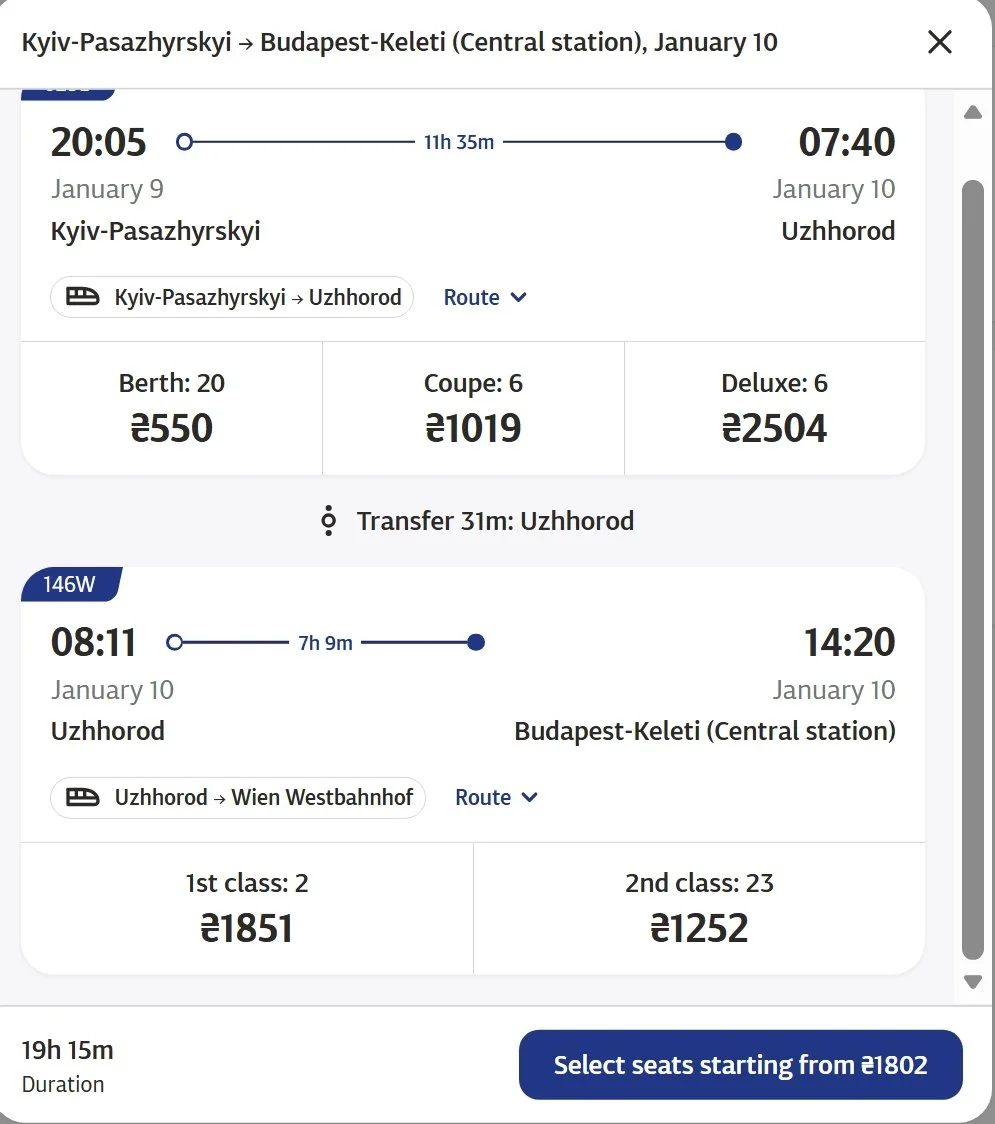
This is not a Ukrainian Railways operation- as are the services from Ukraine into Poland (Przemysl, Chelm) which are operated by Ukrainian Railways and at the border with Poland the carriages adjust their wheelbases to operate within Poland. The MAV locomotives and carriages operate on a section of track in Ukraine that is newly-constructed European standard.
The government of Hungary is the only bordering country of Ukraine operating its passenger trains within the internationally-recognized territory of Ukraine.
The commercial relationship between Budapest and Kyiv is far more elastic than their political relationship. For citizens of Ukraine, that has consequences.
Since 24 February 2022, Viktor Orban, Prime Minister of Hungary (1998-2002 and 2010- ), has embraced commercial, economic, financial, military, political, and social positions inconsistent with the other twenty-six members of the Brussels, Belgium-based European Union (EU) and the other thirty-one members of the Brussels, Belgium-based North Atlantic Treaty Organization (NATO).
EU: Austria, Belgium, Bulgaria, Croatia, Cyprus, Czech Republic, Denmark, Estonia, Finland, France, Germany, Greece, Hungary, Ireland, Italy, Latvia, Lithuania, Luxembourg, Malta, Netherlands, Poland, Portugal, Romania, Slovakia, Slovenia, Spain, Sweden.
NATO: United States, United Kingdom, Belgium, Canada, Denmark, Finland, France, Iceland, Italy, Luxembourg, Netherlands, Norway, Portugal, Albania, Lithuania, Bulgaria, Montenegro, Croatia, Czech Republic, Poland, Estonia, Romania, Germany, Slovakia, Greece, Slovenia, Hungary, Spain, Turkiye, Latvia, and North Macedonia, Sweden.
For Volodymyr Zelensky, President of Ukraine (2019-2024; term extended due to imposition of martial law in 2022), Prime Minister Orban’s decisions, particularly his voting in the EU and in NATO relating to support for the government of Ukraine, are infuriating- and he has said so on many occasions.
Yet, a rapidly completed €28.6 million (US$32.8 million) twenty-two kilometers (16.7 miles) of railway connecting Hungary with Ukraine was far more than symbolic. It also went relatively unnoticed since becoming operational on 5 September 2025.
Government of Ukraine: “The 22-kilometer Uzhhorod–Chop Eurocity line was officially opened on 5 September 2025. The total cost of implementing the project was about 1.3 billion hryvnias. Half of the funds were provided from the EU’s Connecting Europe Facility (CEF), with the remainder contributed by the government of Ukraine. Construction of the Eurocity line began in April 2024. Reconnecting the track to European standards enabled direct services from Uzhhorod to Budapest, and also created convenient routes to Bratislava and Vienna, strengthening the region’s transport and economic links.”
Politically, this section of railway has everything. Supported by Prime Minister Orban. Supported by President Zelensky. Funded in part by the EU, meaning in part by taxpayers in Hungary, and a group (EU) President Zelensky very much wants for the government of Ukraine to be a member- and Prime Minister Orban currently opposes. A demonstration Prime Minister Orban’s positions relating to the Russian Federation-Ukraine War have limits. A demonstration that ego and pride will not prevent President Zelensky from engaging practically with a government he loathes.
EU Media Release
Ukraine opens its first railway line with European track width standard, boosting the country’s integration with the European Union (5 September 2025)
Joint stock company JSC Ukrainian Railways is inaugurating a railway line built to Europe’s track width standard with funding from the European Union.
The new 22 km, 1435 mm gauge line connects the western Ukrainian cities of Uzhhorod and Chop, facilitating freight and passenger rail connectivity with EU countries.
Funded by a European Commission Connecting Europe Facility grant and an EIB loan guaranteed under the Ukraine Facility, this is the first step in a plan to introduce EU-standard railways to other Ukrainian cities.
Ukraine today opened its first railway line based on the EU standard for track width, deepening the country’s transport integration with the European Union. The 22 km line – funded by a European Investment Bank (EIB) loan and an EU grant under the Connecting Europe Facility – connects the city of Uzhhorod on the border with Slovakia to Chop in the south near the border with Hungary. The project is also one of the tangible results of the Ukraine Facility, the European Union’s €50 billion support instrument, showing how European guarantees and grants translate into real infrastructure on the ground.
The new track has a gauge of 1 435 mm – the standard for trans-European rail networks – while the rest of Ukraine's rail network uses broad gauge (1 520 mm). As a result, rail travel journey times between Uzhhorod and Chop and onward to EU cities such as Košice in Slovakia, Budapest in Hungary and Vienna in Austria will be reduced, and rail will become more competitive by avoiding the need to change trains.
The new railway line will also help increasing the volume of goods transported by rail by providing a more efficient and seamless logistics solution, with a positive impact on trade between Ukraine and the European Union. This will not only benefit both economies, but will also contribute to the future reconstruction and recovery of Ukraine. This is part of the efforts under the EU-Ukraine Solidarity Lanes initiative to establish new transport routes and improve existing ones in response to Russia’s illegal full-scale invasion of Ukraine. “This is a historic step towards EU integration. Especially in wartime, when railways serve as a vital lifeline for Ukraine’s economy and people, strengthening these transport links is more important than ever,” said EIB Vice‑President Teresa Czerwińska.
The project amounted to €28.6 million, covering the construction of the 1 435 mm gauge railway track from Chop station to Uzhhorod station and other works along the line. This included the modernisation of the signalling, communication, radio, and microprocessor-based centralised control system, with the aim to increase capacity and improve the safety of rail operators. “Ukrzaliznytsia has become a true lifeline during Russia’s war of aggression – for citizens seeking safety, for businesses sustaining the economy, and as a channel of “iron diplomacy,” bringing world leaders to Ukraine in solidarity and support. Funded by an EIB loan with an EU guarantee and grant, this joint project with Ukrzaliznytsia shows how the concrete results can be achieved even in the most difficult times. It is a first, but very significant step towards fully integrating Ukraine’s railways with the European network, and towards Ukraine’s future inside the European family,” said Ambassador of the European Union to Ukraine Katarína Mathernová.
“The new Uzhhorod-Chop railway line is a tangible step towards integrating Ukraine’s rail network with that of the European Union. With support from the Connecting Europe Facility, we have removed a key break of gauge at the EU border, enabling direct connections with neighbouring Member States. It is a clear example of how the EU is working with Ukraine to build the infrastructure that will underpin its future inside the European family,” said Director-General for Mobility and Transport at the European Commission Magda Kopczyńska.
“This new railway line is more than infrastructure - it is a symbol of Ukraine’s decisive path towards the European Union. By adopting the European track-width standard, Ukraine is not only building physical connections with its neighbours, but also strengthening social and economic ties. Initiatives like this open new opportunities for trade, investment, and jobs, paving the way for gradual integration and access to the EU single market. Each kilometre of new rail brings Ukraine closer to shared prosperity and its future within the European Union,” said Director-General for Enlargement and Eastern Neighbourhood at the European Commission Gert-Jan Koopman.
The new Uzhhorod-Chop railway line is the first step in a plan to build 1 435 mm gauge tracks to Ukrainian cities such as Chernivtsi, Lviv and Kovel – projects aimed at deepening rail connections between Ukraine and the European Union over the next four to five years, followed by the extension of the 1 435 mm gauge tracks to Kyiv. In addition to providing funding, the European Union is offering technical assistance, in particular through the EIB’s JASPERS advisory team. Many of these projects will be backed by the Ukraine Facility, which is designed to mobilise investment at scale for Ukraine’s recovery and EU integration.
The new Uzhhorod-Chop track was co-financed in equal parts by an EIB loan guaranteed by the Ukraine Facility and a grant from the European Commission’s Connecting Europe Facility transport programme overseen by the European Climate, Infrastructure and Environment Executive Agency (CINEA). JSC Ukrainian railways carried out the project. “For the first time in Ukraine’s modern history, a European-gauge railway has been built from scratch – a 22-kilometre stretch between Chop and Uzhhorod. Thanks to this, Uzhhorod has become the first regional centre to gain a direct European-gauge connection with EU countries – including the capitals Bratislava, Budapest and Vienna. This is an important stage in developing a European railway network in Ukraine, and we will continue to build at an even faster pace. Already in 2026, we plan to electrify this section and begin construction of the European-gauge line towards Lviv, which we intend to complete within 2–3 years. With this project, Ukrainian railway workers impressed our European partners — despite the war, we managed to deliver it ahead of schedule. Through such work, Ukrainians have proven that they are ready to implement even more ambitious European integration projects, and that invested funds are quickly converted into tangible results for people,” said Chairman of the Management Board of JSC Ukrainian Railways Oleksandr Pertsovskyi.
Background information
The EIB in Ukraine. Present in Ukraine since 2007, the EIB has stepped up its financial support for the country’s resilience and modernisation since Russia’s full-scale invasion in 2022. Since then, the EIB has provided €3.6 billion in financing. Through its EU for Ukraine (EU4U) Initiative, coupled with its key role in implementing a dedicated window of the Ukraine Facility, the EIB is strongly committed to accelerating its activities in line with the mandate given by EU leaders, in close cooperation with the European Commission, the European Parliament, Member States and international partners.
The Connecting Europe Facility (CEF) is a key EU funding instrument to promote growth, jobs and competitiveness through targeted infrastructure investment at European level. Managed by the European Commission, it supports the development of high-performing, sustainable and efficiently interconnected trans-European networks in the fields of transport, energy and digital services. CEF investments fill the missing links in Europe's energy, transport and digital backbone. The CEF for Transport helps build new or upgrade existing transport infrastructure across Europe. It focuses on cross-border projects and initiatives aimed at removing bottlenecks or bridging missing links. Under the Connecting Europe Facility, the European Commission has provided a total of €110 million in non-reimbursable support (mobilising investment of €220 million) for the integration of the Ukrainian and EU railway systems along the extended TEN-T corridors within Ukraine. This includes significant backing for the development of a European standard gauge railway connecting Poland with Lviv, with an additional €76 million of non-repayable grant support provided this July.
The Ukraine Facility is the European Union’s €50 billion support instrument for 2024 to 2027. It provides predictable financing through grants, loans and guarantees to help Ukraine maintain macro-financial stability, advance reforms on its path to EU accession, and invest in recovery and modernisation. Under its Ukraine Investment Framework, the facility backs projects like the new Chop-Uzhhorod rail line by guaranteeing loans from the European Investment Bank and other partners.