
Baku, Azerbaijan
11 September 2026
Exclusive Opinion
Trump-Xi summit unlikely to end deeper U.S.-China rivalry, expert explains why
John Kavulich explains why the expected Trump-Xi meeting is unlikely to bring lasting change to U.S.-China relations as strategic competition deepens.
By Elchin Mehdiyev

Courtesy of John Kavulich / AA
The expected meeting between President Donald Trump and Chinese President Xi Jinping comes at a consequential moment for relations between the world's two largest economies.
Only months after Trump traveled to China for talks with Xi, attention is now turning to the Chinese leader's expected visit to the United States. The meeting will take place against a much broader geopolitical backdrop, with competition between Washington and Beijing extending from trade and technology to security and global influence.
At the same time, China's role in the expanding BRICS grouping highlights another dimension of the changing international landscape. The BRICS summit in India brings together major emerging economies at a time when questions about the future balance of global economic and political power have become increasingly important.
Against this backdrop, AmericanDiary24 asked John Kavulich, Senior Research Editor at Issue Insight, what the expected Trump-Xi meeting could realistically change in U.S.-China relations — and whether it could create greater strategic stability or whether the deeper rivalry between Washington and Beijing is likely to continue regardless of the outcome.
Kavulich does not expect the meeting to fundamentally transform the relationship.
“There is not, nor should there be optimism that the visit will result in demonstrable and sustainable change in the commercial, economic, financial, military, political, and societal bilateral relationship,” Kavulich told AmericanDiary24.
His assessment points to the scale of the issues separating Washington and Beijing.
U.S.-China competition today extends far beyond the tariffs and trade disputes that frequently dominate headlines. Technology, semiconductors, artificial intelligence, investment, supply chains, military capabilities and international influence have all become important elements of the relationship.
This creates a difficult environment for diplomacy. Even when the two governments find areas where cooperation is possible, broader strategic competition remains.
Kavulich sees that imbalance between competition and cooperation as central to understanding the relationship.
“Beijing and Washington DC have far too many areas of competition that are more important at present to each government than are areas of cooperation.”
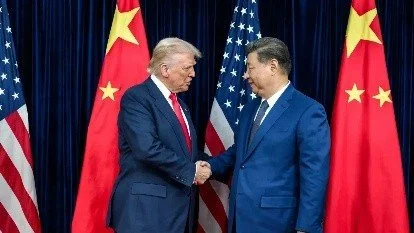
Photo: White House gallery
Two leaders, two competing national ambitions
The expected Washington meeting follows Trump's earlier visit to China, providing the two presidents with another opportunity for direct diplomacy.
Presidential meetings can play an important role in managing tensions between major powers. They can provide channels for communication and create opportunities to address specific disagreements.
But the larger question is whether individual agreements can alter the structural competition developing between the United States and China.
Kavulich frames the fundamental challenge in straightforward terms:
“President Xi wants China to prevail. President Trump wants the United States to prevail. Both government systems- communism and democracy are incompatible with one another. Thus, cooperation remains challenging.”
The comment reflects Kavulich's assessment of why a presidential meeting, even if productive in specific areas, should not necessarily be interpreted as a broader transformation of the bilateral relationship.
Washington and Beijing have strong incentives to prevent their competition from escalating uncontrollably. At the same time, both governments are pursuing national priorities that frequently place them on opposing sides of major economic and geopolitical questions.
The BRICS dimension
The wider international environment adds another layer to the Trump-Xi meeting.
The BRICS summit in India places China alongside a group of emerging powers seeking a greater role in international economic and political affairs.
For Beijing, relationships within BRICS form part of a much broader diplomatic landscape that extends well beyond its relationship with Washington.
For the United States, China's growing engagement with emerging economies is increasingly relevant to questions involving trade, technology, finance and global influence.
This does not mean BRICS represents a unified geopolitical bloc opposed to Washington. Its members have different national interests and maintain different relationships with the United States.
But its expansion demonstrates how the international system is becoming more complex as major emerging economies seek greater influence over global institutions and economic decision-making.
Xi's expected meeting with Trump therefore comes not in isolation, but amid a broader debate about how global power and influence are evolving.
Kavulich points to Xi's UN decision
Kavulich also raised a separate issue concerning Xi's expected visit to Washington: the Chinese president's decision not to attend the United Nations General Assembly in New York.
He views that decision as significant.
“The decision by President Xi not to attend the United Nations General Assembly in New York City while being 207 miles away in Washington DC speaks loudly about what Beijing thinks about the importance of the United Nations.”
Kavulich also argues that an appearance by Xi at the General Assembly could have carried symbolic importance for the organization and its smaller member states.
“Even the optics of attending- he last did so in 2019, would have sent an important signal, even momentarily, as to reinforcing the relevance of the United Nations particularly to the smaller of the 193 member countries.”
The observation adds another dimension to the discussion surrounding Xi's U.S. visit.
China regularly emphasizes the importance of multilateral institutions and presents itself as a supporter of a more multipolar international system. Against that background, decisions about where and how its president chooses to engage internationally can carry diplomatic symbolism beyond the immediate meetings themselves.
Managing rivalry may matter more than ending it
The Trump-Xi meeting will inevitably generate expectations about possible changes in U.S.-China relations.
But there is an important distinction between managing a rivalry and ending one.
Washington and Beijing remain economically connected, while simultaneously competing across some of the most strategically important sectors of the global economy.
That combination means neither confrontation nor cooperation alone adequately describes the relationship. The two governments can reach agreements in individual areas while continuing to compete elsewhere.
Seen from that perspective, the most realistic measure of the upcoming meeting may not be whether Trump and Xi fundamentally reset U.S.-China relations.
It may be whether they can establish enough predictability to prevent their expanding competition from developing into a more dangerous confrontation.
Kavulich's assessment, however, leaves little expectation of a fundamental transformation.
For him, the underlying areas of competition remain too important to both governments for one presidential visit to produce “demonstrable and sustainable change” across the broader U.S.-China relationship.