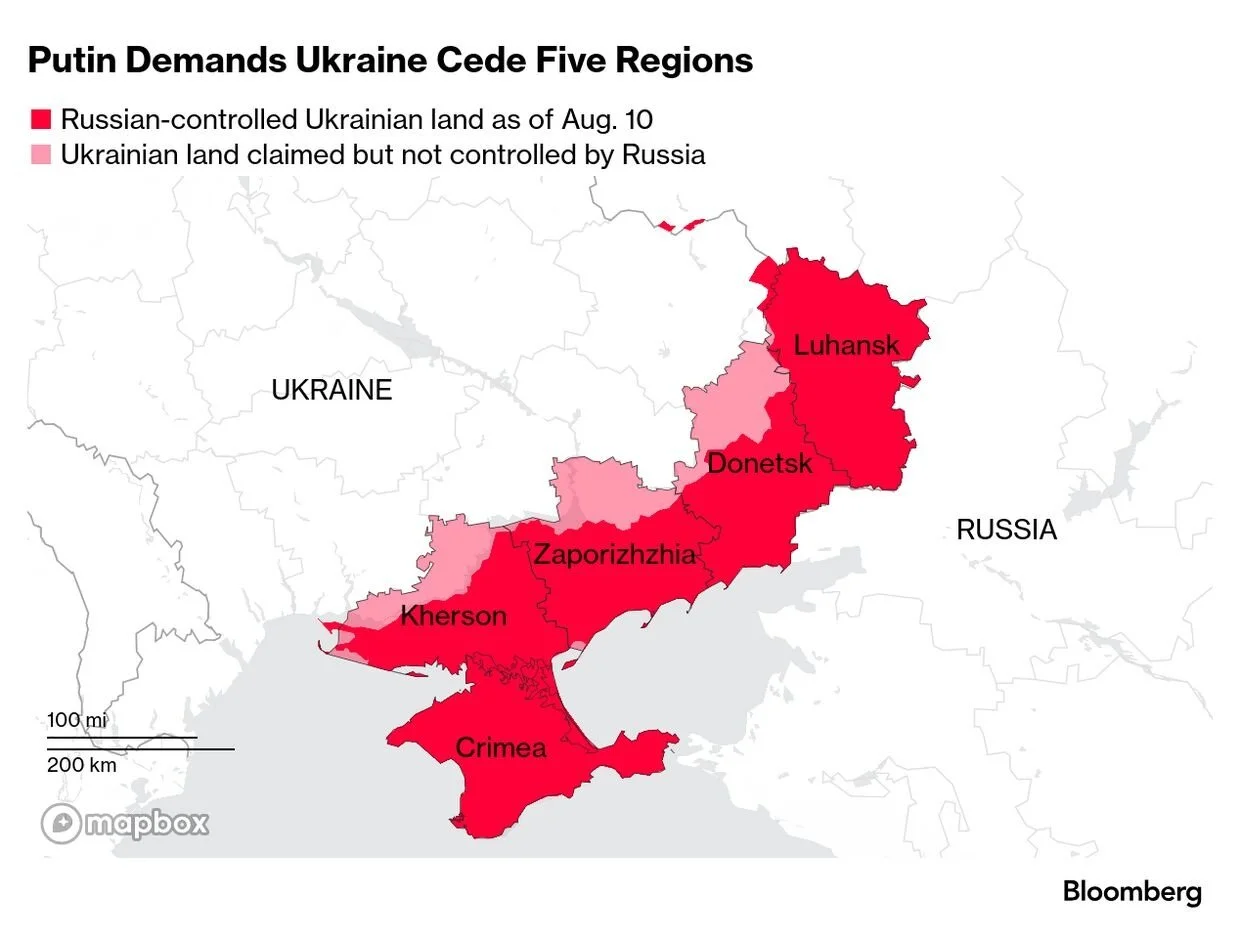
Idea? Shift The Territorial Goalposts.
Ukraine Oblast Boundaries Of Donetsk, Kherson, Luhansk, And Zaporizhzhia Eastward
Russian Federation Wants 100% Four Ukraine Oblasts; They Control Approximately 70% Or More Of Each.
Ukraine Does Not Want To Cede Territory To The Russian Federation That Is Not Controlled (Yet) By The Armed Forces Of The Russian Federation. That’s Reasonable.
Ukraine Could Shift Eastward The Boundaries Of Donetsk, Kherson, Luhansk, And Zaporizhzhia Eastward. In This Way, Ukraine Retains Territory It Controls And President Putin Claims Victory- Over Ukraine, And Particularly Relishing For Him, Claims Victory Over EU And NATO… And End The Military Component Of The War.
The armed forces of the Russian Federation occupy approximately twenty percent (20%) of the internationally-recognized territory of Ukraine.
On 24 February 2022, the armed forces of the Russian Federation invaded and further invaded the territory of Ukraine in what Vladimir Putin, President of the Russian Federation (2000-2008 and 2012- ), defined first as a Special Military Operation (SMO) and on 22 December 2022 defined as a war. The initial invasion of Ukraine by the armed forces of the Russian Federation was in part from the territory of Belarus.
The war between the Russian Federation and Ukraine did not commence on 24 February 2022. The roots began their trajectories on 20 February 2014 when the armed forces of the Russian Federation invaded the Crimean Peninsula and the area known as the Donbas Region (Donetsk Oblast and Luhansk Oblast).
President Putin wants to complete the largest real estate transaction thus far in the 21st century. He is to date apparently willing to have others pay far more than those attempting to dissuade him believe the effort is worth to the taxpayers (and unknown number of future generations of taxpayers) of the Russian Federation.
The naysayers chorus is led by Donald Trump, President of the United States (2017-2021 and 2025-2029), who is by any measure an expert in real estate transactions due to his pre-political global commercial interests leading the New York, New York-based The Trump Organization.
Of the twenty-four oblasts (provinces, regions), the armed forces of the Russian Federation occupy substantially four, excluding the Crimean Peninsula (2.4 million (2022 estimate) which was occupied and then annexed in 2014. The armed forces of the Russian Federation also occupy small areas of Dnipropetrovsk oblast, Kharkiv oblast, Mykolaiv oblast, and Sumy oblast.
Approximately 76% of Donetsk (4.157 million population (2022 estimate))
Approximately 75% of Kherson (1.026 million population (2022 estimate))
Approximately 99% of Luhansk (2.145 million population (2022 estimate))
Approximately 75% of Zaporizhzhia (1.247 million population (2022 estimate))
President Putin maintains, with unclear, but apparent enough for concern addendums and caveats, that once the armed forces of the Russian Federation have complete control of Donetsk oblast, Kherson oblast, Luhansk oblast, and Zaporizhzhia oblast, he is prepared to instruct the armed forces of the Russian Federation to cease military operations within the internationally-recognized territory of Ukraine.
Volodymyr Zelensky, President of Ukraine (2019-2024; term extended due to imposition of martial law in 2022), does not believe him.
A critical question is could President Zelensky convince a majority or super-majority of the 450-seat parliament, Verkhovna Rada, to accept a deal retaining what is controlled by the armed forces of Ukraine and slicing off majority percentages of four oblasts from the internationally-recognized territory of Ukraine? If the constitution requires an all-of-Ukraine citizen vote, would the deal prevail? How would votes be tabulated? Who gets counted?
President Zelensky believes the territorial appetite of President Putin is insatiable and unsatisfiable. The more territory is fed to President Putin, believes President Zelensky, the more territory he will crave. From the perspective of government officials in Kyiv, Ukraine, and other country capitals, President Putin is a crack addict, territory is his crack, and he would rather risk an overdose than seek treatment.
There are others who do not have confidence in statements, or innuendos, from President Putin as to what is required for him to give the order to stop the fighting.
The majority of the twenty-seven-country member Brussels, Belgium-based European Union (EU) do not believe him.
The majority of the thirty-two-country member Brussels, Belgium-based North Atlantic Treaty Organization (NATO) do not believe him.
The majority of the New York, New York-based United Nations Security Council (UNSC), of which the government of the Russian Federation is a permanent member, does not believe him.
In the 193-member New York, New York-based United Nations General Assembly (UNGA), if the question to the delegates is about the veracity of President Putin, that outcome is uncertain. There is no available polling.
For President Trump and members of the Trump-Vance Administration (2025-2029), shifting eastward the borders of the oblasts might define the fairness sought to end the military component of the Russian Federation-Ukraine war.
If President Putin refuses such an offer from President Trump, there would be a meaningful increase in heads of state and heads of government who would then have far greater political latitude to not only enact new sanctions, tariffs, and visa prohibitions, but more robustly enforce existing sanctions, tariffs, and visa prohibitions. Regardless of what President Trump may want.