Mr. President, No To U.S. Taxpayers Spending US$10 Billion For Gaza Reconstruction. United States Congress Should Prevent It. Why Should U.S. Taxpayers Pay For What The IDF Did?
Mr. President, No To U.S. Taxpayers Spending US$10 Billion For Gaza Reconstruction
United States Congress Should Prevent It
Why Should U.S. Taxpayers Pay For What The IDF Did?
Mr. Kushner Is Wrong. There IS A Resource Problem For The Reconstruction Of Gaza. His Allegiance To The State Israel Makes Him Incapable Of Appreciating The Problem
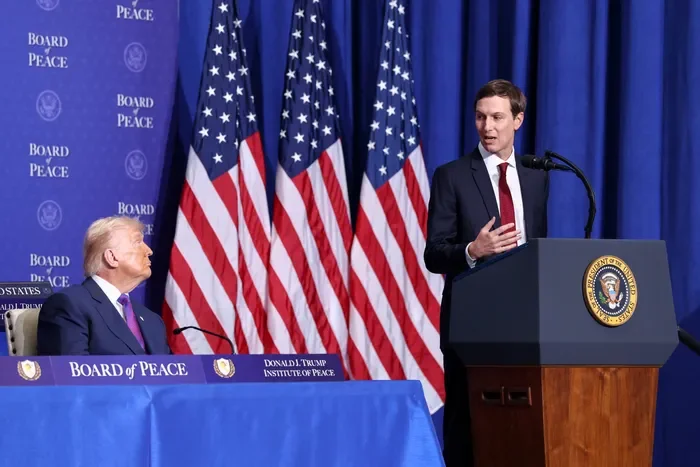
At the 19 February 2026 gathering of the Board of Peace, Jared Kushner, a son-in-law of Donald Trump, President of the United States (2017-2021, 2025-2029), shared for the reconstruction of the territory of Gaza obtaining “resources are not the problem.”
He is wrong. Resources are the problem. Specifically, the sources of the resources. From where the funds are originating and are those origins appropriate?
The twenty-seven-country member Brussels, Belgium-based European Union (EU); New York, New York-based United Nations (UN); and New York, New York-based World Bank believe the funding required for the reconstruction of the territory of Gaza could be US$53 billion.
The government of the Kingdom of Saudi Arabia announced a contribution of US$1 billion, and the government of the United Arab Emirates announced a contribution of US$1.2 billion. Both contributions to be delivered over multi-years with no specificity as to how much during each year.
Embracing raw: Should Muslims pay for what Jews caused? The Israel Defense Forces (IDF) are responsible for the destruction of more than 90% of structures in the territory of Gaza. Muslim taxpayers in Azerbaijan, Bahrain, Egypt, Indonesia, Jordan, Kazakhstan, Kuwait, Lebanon, Morocco, Oman, Pakistan, Saudi Arabia, Syria, Turkiye, United Arab Emirates, and Uzbekistan should not be paying for choices made by the IDF which have impacted- and continue to impact 2.3 million inhabitants of the territory of Gaza.
On 19 February 2026, President Trump announced a US$10 billion contribution to the Board of Peace, created in November 2025 to focus on the territory of Gaza and authorized operationally by the New York, New York-based United Nations (UN) Security Council until 31 December 2027. However, the Board of Peace charter subsequently adopted by President Trump does not mention the territory of Gaza.
Subsequently, in a typical after-action for statements by President Trump, a official of the Trump-Vance Administration “clarified” that the US$10 billion contribution would for a ten-year reconstruction effort “which we will work on in conjunction with [the United States] Congress” with an initial approximately US$1.25 billion for “ordnance removal, temporary housing, security, medical provisions and other needs.”
Likely, the Board of Peace will prioritize State of Israel-based companies, companies with connectivity with the State of Israel, individuals who are citizens of the State of Israel, and individuals who are Jewish and subject to United States jurisdiction. Steven Witkoff, Assistant to the President, Senior Advisor, and Special Envoy (2025- ) of the Trump-Vance Administration, and Mr. Kushner will make certain of that result.
In reality, President Trump is preparing a multi-billion dollar financial and political slush fund to serve as his 401(k)-retirement account- and for the benefit of his family, friends, and as an enticement to those with whom he wants something.
This in the same way that he, his eldest sons, and his company, New York, New York-based The Trump Organization filed a lawsuit seeking US$10 billion from the Internal Revenue Service (IRS) and the United States Department of the Treasury for the unauthorized disclosure of income tax filings by a contractor employed by the IRS. The United States Department of Justice will decide whether to litigate or seek a settlement. The officials who will make that decision are appointed by President Trump- so he is suing the government he leads- and can determine the result. If the United States government authorizes any funds the decision would be nothing more than official theft from United States taxpayers to satisfy greed and grievance of the President of the United States.
President Trump is not intending to fund personally the US$10 billion contribution to the Board of Peace. His preference historically is for others (taxpayers) to fund contributions for which he accepts public adulation. He expects United States taxpayers to fund the US$10 billion contribution from which he will benefit primarily.
The question is why United States taxpayers should contribute US$10 billion for the reconstruction of the territory of Gaza when the party responsible directly for the destruction of the territory of Gaza is the IDF at the behest of the government of the State of Israel.
True, that since 7 October 2023, the IDF has deployed military equipment manufactured by United States-based companies. Under continually renewed statutes, supported by political parties in the United States Congress, the government of the State of Israel receives more than US$3 billion annually- and it uses some of those funds to purchase military equipment. So, the United States Department of Defense and United States Department of State, which approve the military equipment sales, are in a manner co-conspirators along with the IDF.
Perhaps, President Trump believes United States taxpayers have a moral obligation to assist funding the reconstruction of Gaza since United States taxpayer funds paid for much of the ammunition, drones, missiles, and rockets which thus far has destroyed more than 90% of structures in the territory of Gaza and resulted in the deaths of more than 72,000 inhabitants of the territory of Gaza. That potential belief is highly doubtful.
Not requiring an advanced degree in creative writing to predict the outcome for the sourcing and deployment of US$10 billion.
Most or all the US$10 billion, if any of it materializes, will be for President Trump an exercise to triumph over the traditional legislative process.
President Trump may be enticed to first suggest the funds will be from tariffs- so costing taxpayers nothing, which will not be true. He may then seek funds from the United States Department of Defense and United States Department of State with the scripting the funds protect national security. He may argue his financial acumen as resulted in the lowest federal spending deficit “like no one’s seen before” so adding a little more will not matter. He may argue United States-based companies benefit from the deployment of the US$10 billion. But the employment opportunities will not be for United States citizens, they will be for citizens of other countries near the territory of Gaza and, one would hope, employment opportunities for inhabitants of the territory of Gaza.
One certainty is the deployment of the US$10 billion along with the approximately US$6.5 billion from other country taxpayers will benefit the State of Israel- its companies, its financial institutions, its government, its stock market, its taxpayers, and its voters.
Those benefits will be closely aligned with and connected to Messrs. Witkoff and Kushner, who are both Jewish. Will be shocking to no one for them to benefit personally, along with members of their families, and their friends.
From Politico: “Two Israelis on the Board of Peace outlined their plans for reconstruction. Developer Yakir Gabay conjured “a new Mediterranean Riviera with 200 hotels and potential islands” and Liran Tancman promised a “secure digital backbone.” (Tancman was reportedly among the Israeli businessmen who helped set up the Gaza Humanitarian Foundation).”
Board of Peace Charter
PREAMBLE
Declaring that durable peace requires pragmatic judgment, common-sense solutions, and the courage to depart from approaches and institutions that have too often failed; Recognizing that lasting peace takes root when people are empowered to take ownership and responsibility over their future; Affirming that only sustained, results-oriented partnership, grounded in shared burdens and commitments, can secure peace in places where it has for too long proven elusive; Lamenting that too many approaches to peace-building foster perpetual dependency, and institutionalize crisis rather than leading people beyond it; Emphasizing the need for a more nimble and effective international peace-building body; and Resolving to assemble a coalition of willing States committed to practical cooperation and effective action, Judgment guided and justice honored, the Parties hereby adopt the Charter for the Board of Peace.
CHAPTER I-PURPOSES AND FUNCTIONS
Article 1: Mission
The Board of Peace is an international organization that seeks to promote stability, restore dependable and lawful governance, and secure enduring peace in areas affected or threatened by conflict. The Board of Peace shall undertake such peace-building functions in accordance with international law and as may be approved in accordance with this Charter, including the development and dissemination of best practices capable of being applied by all nations and communities seeking peace.
CHAPTER II- MEMBERSHIP
Article 2.1: Member States
Membership in the Board of Peace is limited to States invited to participate by the Chairman, and commences upon notification that the State has consented to be bound by this Charter, in accordance with Chapter XI.
Article 2.2: Member State Responsibilities
(a) Each Member State shall be represented on the Board of Peace by its Head of State or Government. (b) Each Member State shall support and assist with Board of Peace operations consistent with their respective domestic legal authorities. Nothing in this Charter shall be construed to give the Board of Peace jurisdiction within the territory of Member States, or require Member States to participate in a particular peace-building mission, without their consent. (c) Each Member State shall serve a term of no more than three years from this Charter’s entry into force, subject to renewal by the Chairman. The three-year membership term shall not apply to Member States that contribute more than USD $1,000,000,000 in cash funds to the Board of Peace within the first year of the Charter’s entry into force.
Article 2.3: Termination of Membership
Membership shall terminate upon the earlier of: (i) expiration of a three-year term, subject to Article 2.2(c) and renewal by the Chairman; (ii) withdrawal, consistent with Article 2.4; (iii) a removal decision by the Chairman, subject to a veto by a two-thirds majority of Member States: or (iv) dissolution of the Board of Peace pursuant to Chapter X. A Member State whose membership terminates shall also cease to be a Party to the Charter, but such State may be invited again to become a Member State, in accordance with Article 2.1.
Article 2.4: Withdrawal
Any Member State may withdraw from the Board of Peace with immediate effect by providing written notice to the Chairman.
CHAPTER III-GOVERNANCE
Article 3.1: The Board of Peace
(a) The Board of Peace consists of its Member States. (b) The Board of Peace shall vote on all proposals on its agenda, including with respect to the annual budgets, the establishment of subsidiary entities, the appointment of senior executive officers, and major policy determinations, such as the approval of international agreements and the pursuit of new peace-building initiatives.
(c) The Board of Peace shall convene voting meetings at least annually and at such additional times and locations as the Chairman deems appropriate. The agenda at such meetings shall be set by the Executive Board, subject to notice and comment by Member States and approval by the Chairman.
(d) Each Member State shall have one vote on the Board of Peace. (e) Decisions shall be made by a majority of the Member States present and voting, subject to the approval of the Chairman, who may also cast a vote in his capacity as Chairman in the event of a tie. (f) The Board of Peace shall also hold regular non-voting meetings with its Executive Board at which Member States may submit recommendations and guidance with respect to the Executive Board’s activities, and at which the Executive Board shall report to the Board of Peace on the Executive Board’s operations and decisions. Such meetings shall be convened on at least a quarterly basis, with the time and place of said meetings determined by the Chief Executive of the Executive Board. (g) Member States may elect to be represented by an alternate high-ranking official at all meetings, subject to approval by the Chairman. (h) The Chairman may issue invitations to relevant regional economic integration organizations to participate in the proceedings of the Board of Peace under such terms and conditions as he deems appropriate.
Article 3.2: Chairman
(a) Donald J. Trump shall serve as inaugural Chairman of the Board of Peace, and he shall separately serve as inaugural representative of the United States of America, subject only to the provisions of Chapter III. (b) The Chairman shall have exclusive authority to create, modify, or dissolve subsidiary entities as necessary or appropriate to fulfill the Board of Peace’s mission.
Article 3.3: Succession and Replacement
The Chairman shall at all times designate a successor for the role of Chairman. Replacement of the Chairman may occur only following voluntary resignation or as a result of incapacity, as determined by a unanimous vote of the Executive Board, at which time the Chairman’s designated successor shall immediately assume the position of the Chairman and all associated duties and authorities of the Chairman.
Article 3.4: Subcommittees
The Chairman may establish subcommittees as necessary or appropriate and shall set the mandate, structure, and governance rules for each such subcommittee.
CHAPTER IV-EXECUTIVE BOARD
Article 4.1: Executive Board Composition and Representation
(a) The Executive Board shall be selected by the Chairman and consist of leaders of global stature.
(b) Members of the Executive Board shall serve two-year terms, subject to removal by the Chairman and renewable at his discretion. (c) The Executive Board shall be led by a Chief Executive nominated by the Chairman and confirmed by a majority vote of the Executive Board.
(d) The Chief Executive shall convene the Executive Board every two weeks for the first three months following its establishment and on a monthly basis thereafter, with additional meetings convened as the Chief Executive deems appropriate. (e) Decisions of the Executive Board shall be made by a majority of its members present and voting, including the Chief Executive. Such decisions shall go into effect immediately, subject to veto by the Chairman at any time thereafter.
(f) The Executive Board shall determine its own rules of procedure.
Article 4.2: Executive Board Mandate
The Executive Board shall: (a) Exercise powers necessary and appropriate to implement the Board of Peace’s mission, consistent with this Charter; (b) Report to the Board of Peace on its activities and decisions on a quarterly basis, consistent with Article 3.1(f), and at additional times as the Chairman may determine.
CHAPTER V-FINANCIAL PROVISIONS
Article 5.1: Expenses
Funding for the expenses of the Board of Peace shall be through voluntary funding from Member States, other States, organizations, or other sources.
Article 5.2: Accounts
The Board of Peace may authorize the establishment of accounts as necessary to carry out its mission. The Executive Board shall authorize the institution of controls and oversight mechanisms with respect to budgets, financial accounts, and disbursements, as necessary or appropriate to ensure their integrity.
CHAPTER VI LEGAL STATUS
Article 6
(a) The Board of Peace and its subsidiary entities possess international legal personality. They shall have such legal capacity as may be necessary to the pursuit of their mission (including, but not limited to, the capacity to enter into contracts, acquire and dispose of immovable and movable property, institute legal proceedings, open bank accounts, receive and disburse private and public funds, and employ staff). (b) The Board of Peace shall ensure the provision of such privileges and immunities as are necessary for the exercise of the functions of the Board of Peace and its subsidiary entities and personnel, to be established in agreements with the States in which the Board of Peace and its subsidiary entities operate or through such other measures as may be taken by those States consistent with their domestic legal requirements. The Board may delegate authority to negotiate and conclude such agreements or arrangements to designated officials within the Board of Peace and/or its subsidiary entities.
CHAPTER VII-INTERPRETATION AND DISPUTE RESOLUTION
Article 7
Internal disputes between and among Board of Peace Members, entities, and personnel with respect to matters related to the Board of Peace should be resolved through amicable collaboration, consistent with the organizational authorities established by the Charter, and for such purposes, the Chairman is the final authority regarding the meaning, interpretation, and application of this Charter.
CHAPTER VIII-CHARTER AMENDMENTS
Article 8
Amendments to the Charter may be proposed by the Executive Board or at least one-third of the Member States of the Board of Peace acting together. Proposed amendments shall be circulated to all Member States at least thirty (30) days before being voted on. Such amendments shall be adopted upon approval by a two-thirds majority of the Board of Peace and confirmation by the Chairman. Amendments to Chapters II, III, IV, V, VIII, and X require unanimous approval of the Board of Peace and confirmation by the Chairman. Upon satisfaction of the relevant requirements, amendments shall enter into force on such date as specified in the amendment resolution or immediately if no date is specified.
CHAPTER IX-RESOLUTIONS OR OTHER DIRECTIVES
Article 9
The Chairman, acting on behalf of the Board of Peace, is authorized to adopt resolutions or other directives, consistent with this Charter, to implement the Board of Peace’s mission.
CHAPTER X-DURATION, DISSOLUTION AND TRANSITION
Article 10.1: Duration
The Board of Peace continues until dissolved in accordance with this Chapter, at which time this Charter will also terminate.
Article 10.2: Conditions for Dissolution
The Board of Peace shall dissolve at such time as the Chairman considers necessary or appropriate, or at the end of every odd-numbered calendar year, unless renewed by the Chairman no later than November 21 of such odd-numbered calendar year. The Executive Board shall provide for the rules and procedures with respect to the settling of all assets, liabilities, and obligations upon dissolution.
CHAPTER XI-ENTRY INTO FORCE
Article 11.1: Entry into Force and Provisional Application
(a) This Charter shall enter into force upon expression of consent to be bound by three States. (b) States required to ratify, accept, or approve this Charter through domestic procedures agree to provisionally apply the terms of this Charter, unless such States have informed the Chairman at the time of their signature that they are unable to do so. Such States that do not provisionally apply this Charter may participate as Non-Voting Members in Board of Peace proceedings pending ratification, acceptance, or approval of the Charter consistent with their domestic legal requirements, subject to approval by the Chairman.
Article 11.2: Depositary
The original text of this Charter, and any amendment thereto shall be deposited with the United States of America, which is hereby designated as the Depositary of this Charter. The Depositary shall promptly provide a certified copy of the original text of this Charter, and any amendment or additional protocols thereto, to all signatories to this Charter.
CHAPTER XII RESERVATIONS
Article 12
No reservations may be made to this Charter.
CHAPTER XIII-GENERAL PROVISIONS
Article 13.1: Official Language
The official language of the Board of Peace shall be English
Article 13.2: Headquarters
The Board of Peace and its subsidiary entities may, in accordance with the Charter, establish a headquarters and field offices. The Board of Peace will negotiate a headquarters agreement and agreements governing field offices with the host State or States, as necessary.
Article 13.3: Seal
The Board of Peace will have an official seal, which shall be approved by the Chairman.
IN WITNESS WHEREOF, the undersigned, being duly authorized, have signed this Charter.